Assisted Living vs Nursing Home Costs in Lincoln, NE
Lincoln care medians show why the right comparison includes daily needs, likely changes in care, and the full monthly budget.
Families searching for “assisted living vs nursing home cost Lincoln NE” are often trying to answer two questions at once: what kind of support is needed, and what will that support cost over time? Those questions should stay together. A nursing home and an assisted living community are not simply two price points for the same service. In Lincoln, monthly medians show a clear difference, but the right choice depends on nursing needs, supervision, daily routines, and how care may change. The figures below are survey medians for the Lincoln metro, not quotes for any community. They offer a starting point for a budget and for better conversations with providers, discharge planners, and insurers.
Care levels come before price
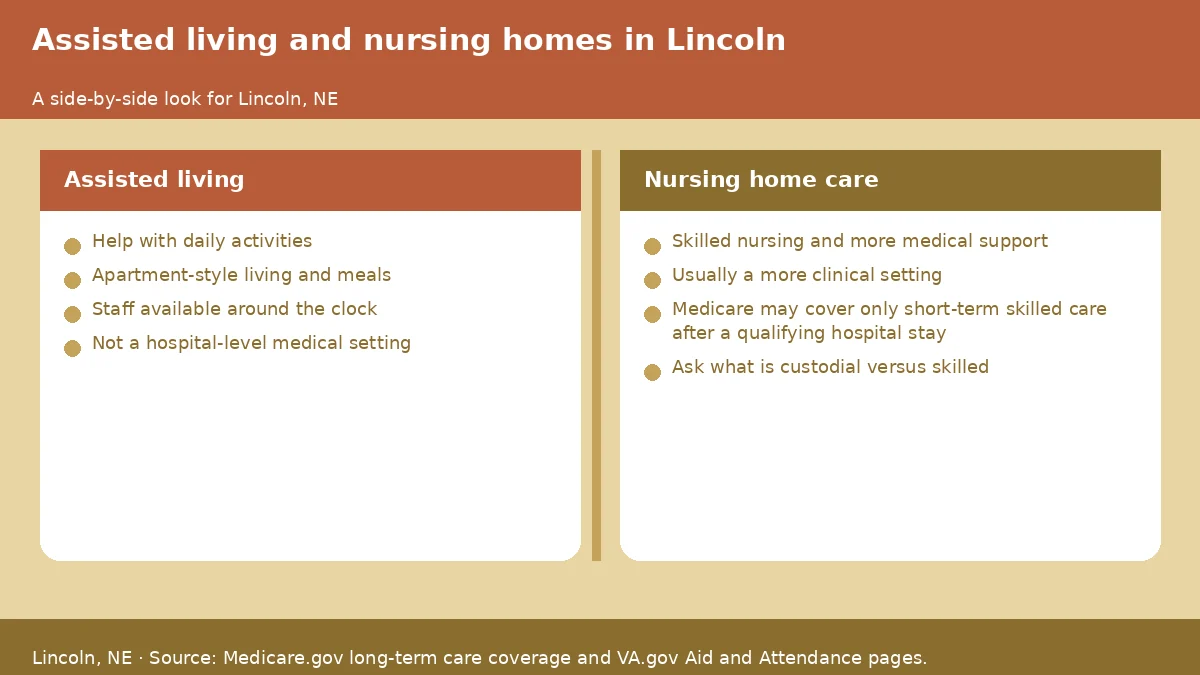
Assisted living generally provides a residential setting with help for daily activities, while leaving room for privacy, routines, and social connection. Depending on the community, support can include personal care, meals, medication assistance, housekeeping, and planned activities. The central question is whether the person can be supported safely without the continuous nursing services associated with a nursing home.
A nursing home provides a more clinical level of supervision and can serve people with substantial nursing needs, complex functional limitations, or a need for rehabilitation after an illness or hospital stay. Some stays are short; others become long-term residences. A higher price does not mean assisted living is a lesser option for everyone. It means the settings are built around different needs. Paying for nursing home care when that level is unnecessary can strain a budget, while choosing assisted living without enough support can lead to another difficult transition.
Assisted living vs nursing home cost in Lincoln, NE
The reports the following Lincoln metro figures. Assisted living is compared with semi-private and private nursing home rooms, using the survey's reported monthly and annual amounts.
Those are differences between settings, not savings an individual family can count on. A person's care assessment, the room selected, and each provider's charges determine an actual bill. The comparison is most useful when the same person could appropriately be supported in either setting.
What the Lincoln cost gap does—and does not—show
Lincoln's assisted living median is also higher than broader benchmarks. A local median keeps the comparison grounded in Lincoln rather than suggesting that a statewide or national number is a local quote.
These differences should shape planning, not make the decision by themselves. Annual figures reveal the weight of a continuing arrangement, but no stay is guaranteed to last a year, and rates or care charges may change. Families comparing assisted living in Lincoln should request an individualized estimate, ask which services are included, and identify what could trigger a higher care charge. That makes assisted living vs nursing home cost in Lincoln, NE a practical budget discussion rather than a simple ranking.
Why home-care schedules change the comparison
It may support a daytime routine, but it does not provide overnight supervision. Home-care estimates also should not be compared with a residential fee without listing housing, food, utilities, home upkeep, transportation, and backup coverage. The useful question is not which category looks cheapest in isolation. It is which arrangement reliably covers the hours and tasks that would otherwise fall to family.
When each setting may be appropriate
Assisted living may fit when someone needs regular help with daily activities but does not require the nursing intensity of a nursing home. A nursing home may be more appropriate when licensed nursing care, close clinical supervision, or extensive physical assistance is central to daily safety. A discharge planner or clinician can help identify current needs, but families should also ask what happens if those needs increase and whether a transfer would then be necessary.
Respite care serves a different purpose. The National Institute on Aging explains that it gives family caregivers a short-term break and can occur at home, in an adult day center, or during a short residential stay. It can create time to rest, attend to other responsibilities, or complete a careful comparison without making a permanent commitment.
Families considering a short residential stay in Lincoln can ask about Prairie View Senior Living of Nebraska's respite care and how the available support relates to their present needs. Respite should be understood as temporary support, not evidence that every future care need can be met in the same setting.
Medicare's limits in a long-term care decision
Medicare is often expected to solve the nursing home question, but its long-term care coverage is limited. Medicare.gov states that Medicare does not cover long-term custodial care when that is the only care needed, and that most long-term care is custodial. Help with bathing, dressing, meals, and supervision can therefore remain a substantial personal expense even when someone has Medicare.
This does not mean every service received in a nursing home is treated the same way. Families should ask which service is being billed, whether it is skilled or custodial, and who is expected to pay for room, board, and ongoing personal assistance. A hospital stay or a care recommendation should not be treated as automatic proof of Medicare coverage.
Medicaid, VA benefits, and long-term care insurance
Nebraska's Medicaid waiver
Nebraska's Medicaid Aged and Disabled Waiver can pay for assisted living services in a participating community for eligible Nebraska Medicaid members who are age sixty-five or older, or have a disability, and meet nursing facility level-of-care criteria. Covered services can include personal care, medication assistance, housekeeping, laundry, transportation, and social activities. According to the Nebraska DHHS waiver guidance, participants pay room and board plus any Medicaid share of cost. The waiver can also support in-home services and respite. It should not be assumed to cover an entire Lincoln assisted living bill.
VA pension and Aid and Attendance
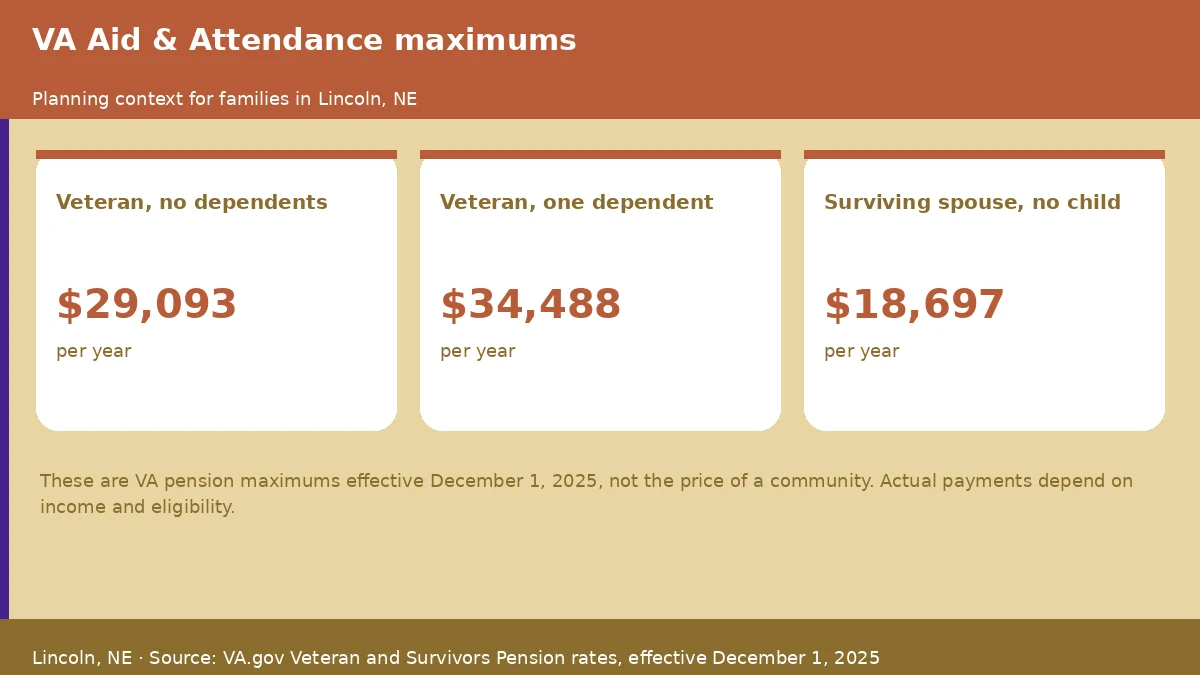
VA Aid and Attendance is an increase to a VA pension for eligible wartime-era Veterans or surviving spouses who meet care or other criteria. The current VA pension rates list a maximum annual pension rate with Aid and Attendance of $29,093 for a Veteran with no dependents and $34,488 for a Veteran with one dependent. These are maximum pension figures, not automatic payments to a community.
The pension calculation subtracts countable income, and certain unreimbursed medical expenses can affect that calculation. The applicable VA net worth limit is $163,699. VA also reviews certain asset transfers before a claim and may apply a penalty period. A VA-accredited representative can help a family avoid treating a maximum rate as a guaranteed benefit.
Long-term care insurance
Long-term care insurance may pay for assisted living, depending on the policy. Benefits commonly begin after an elimination period and when policy triggers involving daily activities or cognitive impairment are met. Read the policy for covered settings, benefit limits, waiting periods, and documentation requirements rather than relying on its name.
A practical checklist for Lincoln families
A useful comparison starts with a written list of needs: personal care, mobility, medication support, meals, supervision, nursing services, and the help family can realistically provide. Take the same list to every provider. Ask for a written estimate, included services, additional care charges, room-related differences, rate-increase practices, and the circumstances that could require a move.
Licensing is a separate checkpoint. The Nebraska DHHS Division of Public Health licenses assisted living facilities, with initial licensure involving document review and inspection. That oversight establishes a baseline; it does not decide whether a particular community fits an individual.
The Lincoln medians in this article are not Prairie View Senior Living of Nebraska's prices. The community offers assisted living and respite care only, not nursing home care, and families should call directly for current rates and an explanation of what is included. Keep that written estimate beside any nursing home quote, insurance explanation, and benefit determination.
A careful comparison makes trade-offs visible before a crisis narrows the choices. Cost matters, but so do the level of support, the responsibilities left with family, and the plan for handling a change in needs.
Frequently asked questions
Is assisted living always less expensive than a nursing home in Lincoln?
Lincoln survey medians are lower for assisted living than for either semi-private or private nursing home rooms, but that does not make it universally cheaper. Care needs, room type, community fees, and rate changes affect the actual bill. Assisted living also cannot substitute for nursing care a person needs. Compare written estimates for the same services rather than choosing on monthly price alone.
Does Medicare pay for long-term assisted living in Lincoln, NE?
Medicare generally does not cover long-term custodial care when that is the only care needed, and most long-term care is custodial. That limit applies in Lincoln just as it does elsewhere. Ask a provider to separate any eligible skilled service from ongoing room, board, and personal assistance, and request a clear explanation of what is being billed.
Can Nebraska Medicaid help with assisted living in Lancaster County?
Nebraska's Medicaid Aged and Disabled Waiver can pay for assisted living services in a participating community for eligible members who meet nursing facility level-of-care criteria. Participants still pay room and board and any applicable share of cost. Participation and eligibility must be confirmed. Lancaster County families can ask Nebraska DHHS and each community how the waiver works before assuming it will cover the full monthly bill.
What should a Lincoln family ask for in a cost comparison?
Ask for a written monthly estimate based on the person's current assessment, then list what is included and what costs extra. Request any care-level charges, community or move-in fees, second-person charges if relevant, rate-increase practices, and discharge terms. For a nursing home, also clarify room type and payer arrangements. Use the same needs list with every provider so the estimates describe comparable situations.
Is respite care useful when choosing between these settings?
Respite care can give a family caregiver a short-term break through in-home help, an adult day program, or a short residential stay. In Lincoln, it may provide breathing room while a family gathers assessments and compares options. Prairie View Senior Living of Nebraska offers assisted living and respite care only. A respite stay should not be treated as proof that a setting will meet every future need.
Talk with Prairie View Senior Living of Nebraska
If you are weighing care options in Lincoln, call 1-800-592-2807 or contact and tours. Our team can talk through current availability, rates and next steps. Please confirm all details directly, since published figures and listings change over time.
Sources
- VA Aid and Attendance and Housebound benefits
- VA pension rates (current)
- Medicare: long-term care coverage
- National Institute on Aging: What is respite care?
- ACL: What is long-term care insurance
- Nebraska DHHS: Assisted Living Facilities licensure
- Nebraska DHHS: Services on the Medicaid Aged and Disabled Waiver
Program rules and benefit amounts were checked on the linked official pages in November 2026 and can change.