Respite Care in Lincoln, NE: Short-Term Support for Family Caregivers
A practical guide to respite options, Lincoln cost benchmarks, payment questions, and preparation for a first short stay.
Respite care in Lincoln NE gives a family caregiver time away while another person or program takes over agreed care tasks. The break may last part of a day, a weekend, or a longer planned stay. It can support a spouse who needs sleep, an adult child balancing work, or a caregiver who simply needs time for personal errands and appointments. Respite is not a single building or benefit. It is a temporary arrangement, and its usefulness depends on matching the setting, supervision, schedule, and personal routines to the older adult’s needs.
What respite care means for Lincoln families
The National Institute on Aging explains respite care as short-term relief for family caregivers. It can take place at home, in an adult day center, or during a short stay in a residential setting. The person receiving care continues to need assistance and supervision appropriate to the setting; the caregiver gains a defined period when someone else shares those responsibilities.
A first break does not have to be lengthy. A caregiver might begin with several daytime visits or a brief residential stay before deciding what schedule is manageable. Respite can also be arranged before a caregiver travels or during a particularly demanding week. Planning ahead allows both people to discuss the arrangement without the pressure of an immediate crisis.
The the National Institute on Aging’s respite care guidance also emphasizes that caregivers supporting someone with dementia may use respite. That does not mean every respite provider offers specialized memory care. The service label, staff responsibilities, environment, and supervision should each be discussed directly.
Three ways to arrange a short break
In-home respite brings assistance to the older adult’s familiar surroundings. Families should clarify whether the visit includes companionship, personal care, meal help, medication reminders, or other tasks. They should also ask who provides supervision, how schedule changes are handled, and whether the caregiver must remain reachable.
Adult day programs provide care during scheduled daytime hours. This option may fit a caregiver who works or needs recurring blocks of personal time. Transportation, arrival times, meals, personal care, accessibility, and the process for late pickup are practical details to settle before the first visit.
Short residential stays place support, meals, and overnight arrangements in one setting. They can be useful when a caregiver will be away overnight or when round-the-clock help at home is impractical. Families considering this option can review Prairie View’s respite care information and then confirm the available dates, length of stay, assessment process, and included services.
Prairie View Senior Living of Nebraska is located at 3534 S 48th St in southeast Lincoln and offers assisted living and respite care only. It does not offer memory care. A respite stay there should not be described as specialized dementia care. Memory care refers to dedicated support, supervision, and environment, so families seeking that setting should ask other providers specifically about their memory care services.
Planning respite care in Lincoln NE around local costs
The provides useful planning benchmarks for the Lincoln metro.
The monthly home care equivalents show why the number of hours matters as much as the hourly rate. Limited weekly help and continuous coverage are very different arrangements. Overnight needs, weekends, holidays, minimum visit lengths, and more than one caregiver can also affect an actual bill.
A family using occasional adult day visits or a few in-home visits should build a budget from its own schedule rather than treating a monthly median as its expected total. Ask for written rates and a sample invoice. For Prairie View’s current respite rates, availability, minimum stay, and included services, families should call 1-800-592-2807; no facility-specific price is stated here.
Putting Lincoln’s wider care costs in context
A separate look at helps prevent misleading comparisons. These are full monthly medians, not prices for a brief respite stay.
Each option addresses different needs, includes different services, and requires a different comparison. The least expensive line on a table is not necessarily adequate support, and a residential rate should not be compared with home care without accounting for housing, meals, and unpaid family caregiving.
Medicaid, Medicare, insurance, and VA benefits
Nebraska’s Medicaid Aged and Disabled Waiver
The Nebraska DHHS Aged and Disabled Waiver page lists respite among its covered services, along with in-home services. For assisted living services, the waiver can pay for personal care, help with daily activities, medication assistance, housekeeping, laundry, transportation, and social activities in a participating facility. Eligibility includes Nebraska Medicaid membership, being age 65 or older or having a disability, and meeting nursing facility level of care.
This is not automatic payment for every respite stay in Lincoln. Participants in assisted living pay room and board plus any Medicaid share of cost. Families should confirm provider participation, the authorized service and setting, the approved dates, and any amount the participant must pay before making a reservation.
Other possible payment sources
Medicare’s long-term care coverage guidance says Medicare does not cover long-term custodial care when that is the only care needed, and most long-term care is custodial. A caregiver’s need for a break does not, by itself, make a residential respite stay payable by Medicare.
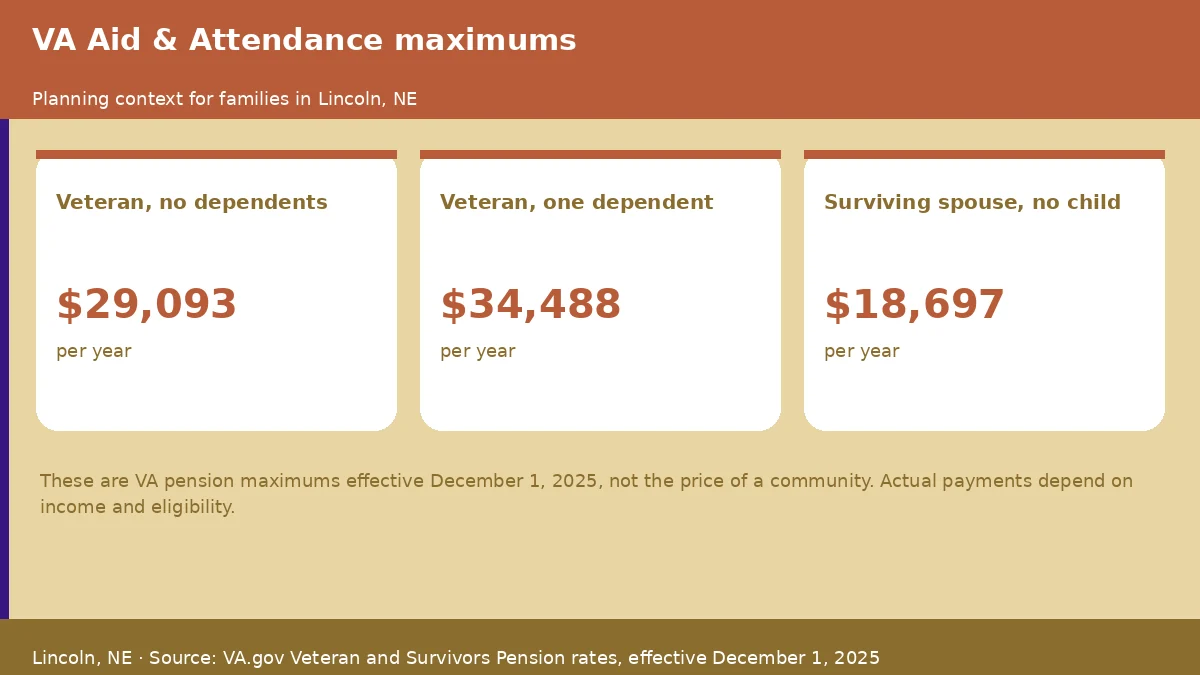
Long-term care insurance may help with assisted living or other services, depending on the policy. Benefits commonly depend on an elimination period and triggers involving daily activities or cognitive impairment. Ask whether short stays, adult day care, or in-home respite qualify rather than assuming they do. Wartime-era Veterans and surviving spouses can also review VA Aid and Attendance eligibility; it is an increased amount added to a VA pension for qualifying circumstances, not a universal respite benefit.
Preparing for a first residential respite stay
A calm handoff begins with specific, written information. The goal is to help the provider understand the person’s ordinary day, not to present an idealized version of it.
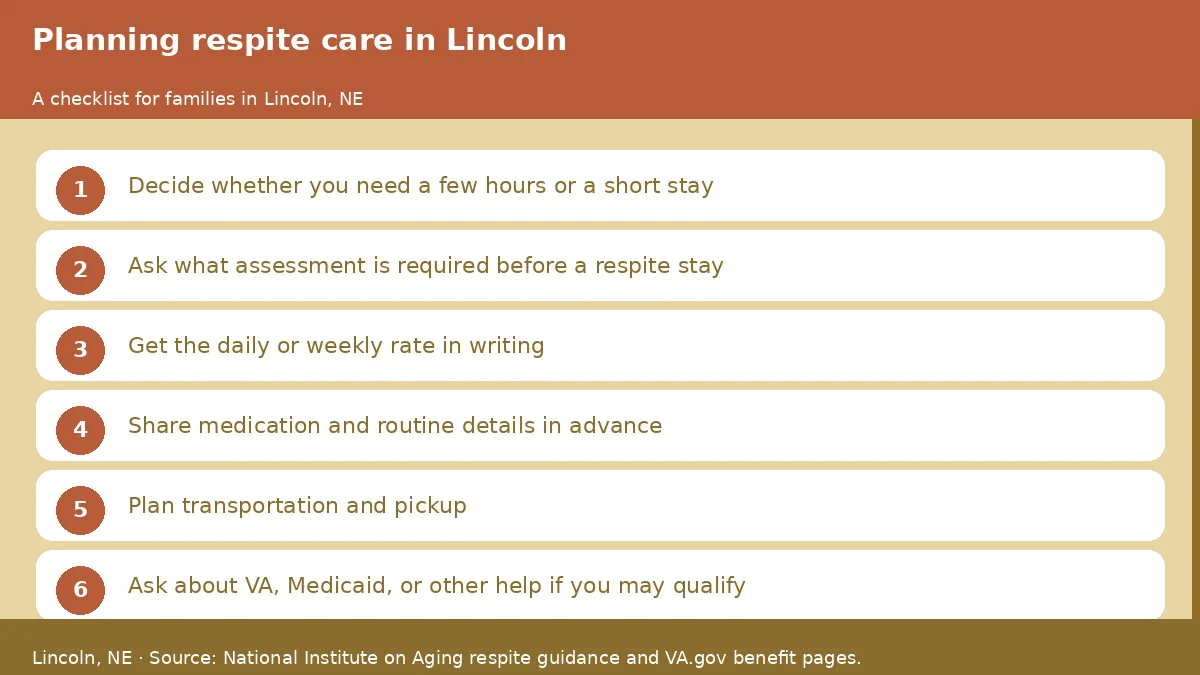
- Confirm the practical terms. Put arrival and departure times, the length of stay, included services, additional charges, cancellation terms, and the main contact person in writing.
- Complete the requested assessment honestly. Describe walking, transfers, bathing, dressing, toileting, eating, sleep, communication, and supervision needs. Mention recent changes rather than waiting for staff to discover them.
- Organize medication and health information. Follow the provider’s instructions for medication packaging and records. Supply requested prescriber, pharmacy, allergy, diagnosis, and emergency contact information without making last-minute medication changes on your own.
- Describe routines and preferences. Explain usual waking and meal times, food preferences, mobility aids, hearing or vision needs, communication style, and activities the person enjoys. Include situations that cause confusion or distress and the supportive responses the family uses.
- Pack simply. Bring labeled clothing, toiletries, required mobility equipment, chargers, and a few familiar personal items. Ask what furniture, linens, and supplies are already provided and what valuables should remain at home.
- Agree on communication. Decide who may receive updates, when the provider should call, and how the family will handle questions after arrival. Keep one copy of the key information accessible during the stay.
A short familiarization visit can help families observe the entrance, dining area, bathroom access, and general environment. Use the contact and tours page to ask about arranging a visit and what records to bring.
Questions to ask before confirming dates
Residential and community providers may use similar words for different service packages. A concise written checklist can make comparisons more reliable.
- Who assesses the person before admission, and what needs could make this setting unsuitable?
- What supervision is available during the day and overnight, and how are requests for assistance handled?
- Which personal care, medication assistance, meals, laundry, activities, and transportation services are included?
- What charges apply for higher assistance needs, supplies, early departure, cancellation, or an extended stay?
- How are emergencies, changes in condition, hospital preferences, and family notifications handled?
- If dementia is present, what support and supervision are actually provided, and is the setting specifically memory care?
For an assisted living setting, families can also ask to confirm current Nebraska licensure. The Nebraska DHHS assisted living licensure page explains that a facility must be licensed before operating or holding itself out as an assisted living facility. Initial licensure includes document review and inspection, with standards under Title 175 Nebraska Administrative Code Chapter 4.
Making respite part of a sustainable care plan
After the first arrangement, record what worked and what needs adjustment. Consider whether the schedule provided a real break, whether the handoff information was sufficient, and whether the older adult’s routines were understood. A difficult first conversation does not settle every future decision, but it can reveal which setting and length of stay deserve another look.
For respite care in Lincoln NE, recurring plans are often easier to evaluate than emergency decisions. Families comparing several services can use the Eldercare Locator from the U.S. Administration for Community Living to connect with local aging resources. Combining that guidance with written provider terms, realistic hours, and a clear understanding of payment responsibilities gives caregivers a steadier basis for planning their next break.
Frequently asked questions
Does Prairie View Senior Living of Nebraska provide memory care during respite stays?
No. Prairie View Senior Living of Nebraska offers assisted living and respite care only and does not offer memory care. A short stay should not be assumed to include specialized dementia support. Memory care generally describes dedicated support, supervision, and environment for people living with dementia. Families seeking that service in Lincoln should ask providers directly whether they operate a memory care setting and what supervision it includes.
Does Nebraska’s Medicaid Aged and Disabled Waiver cover respite care?
Nebraska DHHS lists respite among the services covered by the Medicaid Aged and Disabled Waiver. This does not mean every Lincoln respite stay is automatically paid. Assisted living waiver services require Nebraska Medicaid eligibility, age 65 or older or a disability, nursing facility level of care, and a participating facility. Participants pay room and board plus any Medicaid share of cost. Confirm authorization, provider participation, dates, and personal charges before booking.
Will Medicare pay for respite care in Lincoln?
Medicare generally does not cover long-term custodial care when that is the only care needed, and most long-term care is custodial. A caregiver’s need for a break does not by itself turn a respite stay into a covered service. Families should not assume that Medicare will pay for assisted living respite. Before confirming dates, ask how supervision, personal care, meals, room, and board will be funded and whether any separate coverage applies.
What should we pack for a first residential respite stay in Lincoln?
Pack labeled clothing, toiletries, prescribed medication records in the format requested by the provider, mobility aids, hearing or vision equipment, chargers, and a few familiar personal items. Bring emergency contacts and requested health, pharmacy, allergy, and insurance information. A written daily routine is also useful. Ask in advance about linens, furnishings, incontinence supplies, laundry, valuables, and dietary needs so the stay does not begin with avoidable uncertainty.
How can we estimate a respite care budget in Lincoln?
Start with the setting, dates, hours, overnight needs, and personal assistance required. These are benchmarks, not provider quotes or a complete short-stay budget. Ask for written rates, minimum visit or stay requirements, and extra charges. For Prairie View’s current respite rates and availability, call 1-800-592-2807.
Talk with Prairie View Senior Living of Nebraska
If you are weighing care options in Lincoln, call 1-800-592-2807 or contact and tours. Our team can talk through current availability, rates and next steps. Please confirm all details directly, since published figures and listings change over time.
Sources
- VA Aid and Attendance and Housebound benefits
- Medicare: long-term care coverage
- Eldercare Locator (U.S. Administration for Community Living)
- National Institute on Aging: What is respite care?
- the National Institute on Aging: respite care
- ACL: What is long-term care insurance
- Nebraska DHHS: Assisted Living Facilities licensure
- Nebraska DHHS: Services on the Medicaid Aged and Disabled Waiver
Program rules and benefit amounts were checked on the linked official pages in November 2026 and can change.
Related reading on this site: